Your Dough Is Talking — Here's How to Actually Listen
Every bread baker has been there. You set the timer for two hours, the alarm goes off, and you stare at the bowl wondering: is this actually ready? Maybe it looks a little bigger. Maybe it looks a lot bigger. Maybe it smells a little funky in a way you can't quite place. You poke it, shrug, and move forward — hoping for the best.
Here's the thing: your dough was communicating with you the entire time. You just didn't know the language yet.
Fermentation isn't a passive waiting game. It's a living, breathing biological process — one that responds to the temperature of your kitchen, the strength of your starter or yeast, the protein content of your flour, and even the humidity in the air. A timer can't account for any of that. But you can, once you know what to look for.
Why Timers Are Just Suggestions
Recipes are written in controlled environments. When a cookbook author says "bulk ferment for 3 to 4 hours," they mean in their kitchen, on that day, with their flour and their starter. Your kitchen in July in Phoenix is not the same as their kitchen in November in Vermont. Yeast activity roughly doubles for every 15-degree Fahrenheit rise in temperature — so a dough that takes four hours at 68°F might be fully fermented in under two hours at 80°F.
This isn't a flaw in the recipe. It's just the reality of working with a living organism. The timer gives you a window to pay attention in. The dough tells you when to close it.
The Visual Cues That Actually Matter
Volume increase is the most obvious signal, but it's also the most misunderstood. You've probably heard "wait until it doubles," and while that's a useful benchmark for some doughs, it's not universal. A lean sourdough loaf might only need to increase by 50 to 75 percent before it's ready for shaping. An enriched dough loaded with butter and eggs might genuinely need to double — or more.
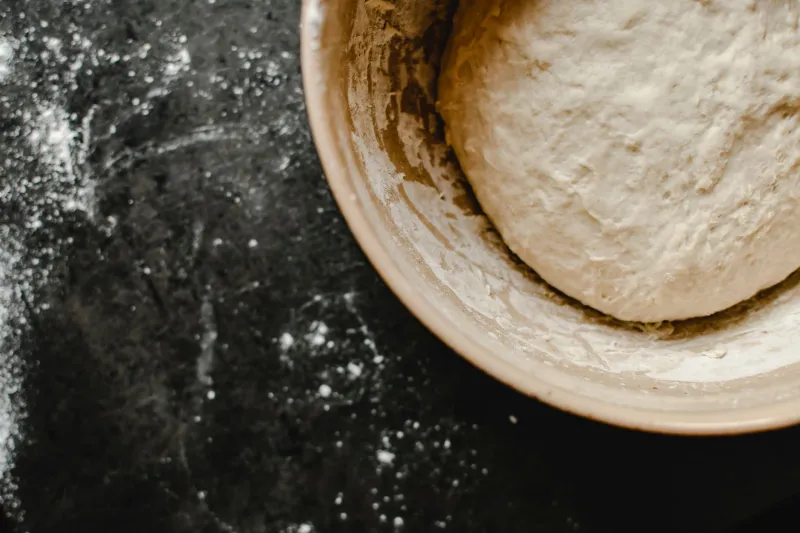
What you're actually watching for is how the dough is growing. Early in fermentation, the surface will look dense and tight. As gas bubbles develop internally, you'll start to see the dough dome slightly at the top. The surface will begin to look more relaxed — less like a taut balloon and more like something gently inflated from within. Some bakers describe it as the dough "breathing."
By the end of a successful bulk ferment, you should also see bubbles. Not just at the top — look at the sides of your clear container if you're using one. A healthy ferment shows a network of small bubbles throughout, evidence that your yeast is working evenly through the mass.
Touch: The Feedback You Can't Fake
Your hands are the most underused diagnostic tool in bread baking. During bulk fermentation, check in on your dough every 45 minutes or so. Give it a gentle press with a dampened finger.
Early on, the dough will feel tight and resistant — it'll push back against your finger almost immediately. That's gluten doing its job, plus yeast that hasn't built up much gas pressure yet. As fermentation progresses, the dough will feel progressively more extensible. It'll hold an indent a little longer before springing back. That gradual softening is normal and expected.
By the end of bulk, the dough should feel noticeably airy and pillowy — almost like pressing into a very soft foam. It should still have some tension and structure; if it feels completely slack and wet, you've likely over-fermented. A well-fermented dough has a gentle jiggle to it when you shake the bowl. Think: Jell-O that hasn't quite set. That wobble is a good sign.
For the final proof — whether in a banneton on the counter or in a loaf pan in the fridge — the poke test becomes your best friend. Press a floured finger about half an inch into the shaped dough. If it springs back immediately and completely, it needs more time. If it doesn't spring back at all and the indent just stays there, you've proofed too long. The sweet spot is when the indent springs back slowly, about halfway. That's your dough telling you it's ready for the oven.
What Your Nose Knows
Smell is the most overlooked fermentation cue, and it's genuinely one of the most informative. A healthy, active dough develops a pleasant, slightly tangy, yeasty aroma over the course of bulk fermentation. If you're working with a sourdough starter, you might notice hints of yogurt or mild vinegar — that's lactic acid bacteria at work, and it's a good thing.
If your dough starts smelling sharply acidic — almost like nail polish remover or rubbing alcohol — that's a sign fermentation has gone too far. Ethanol production ramps up when yeast runs out of available sugars and starts breaking down other compounds. That smell means your window has likely closed.
A dough that smells like almost nothing, even after several hours, is telling you something too: fermentation may be stalled. Check your kitchen temperature, consider whether your starter was active enough, and make sure your flour had enough available sugars to feed the process.
Building Your Fermentation Intuition
None of this becomes second nature overnight. The bakers who seem to "just know" when their dough is ready have simply made enough loaves to recognize the patterns. The good news is that you can accelerate that learning curve significantly by treating each bake as a data point rather than a one-off event.
Keep a simple baking journal. Note your kitchen temperature, the time fermentation started, what the dough looked and felt like at each check-in, and what the final result tasted like. Over time, you'll start connecting those mid-process observations to outcomes — and that's when the real confidence kicks in.
You can also use a clear straight-sided container for bulk fermentation and mark the starting level with a rubber band or piece of tape. That visual reference makes it much easier to track volume increase objectively rather than guessing.
The Relationship Between Baker and Biology
There's something genuinely satisfying about moving past the timer and into a real conversation with your dough. It shifts the dynamic from anxious waiting to engaged observation. You stop being a passive participant and start being a partner in the process.
Fermentation is the heart of bread baking. It's where flavor develops, where structure forms, where a shaggy mass of flour and water starts becoming something worth pulling out of the oven. When you learn to read the cues — the dome, the bubbles, the jiggle, the smell, the slow spring-back — you're not just baking better bread. You're understanding what's actually happening in that bowl.
And once you understand it, no recipe can mislead you. You'll know what ready looks like, feels like, and smells like. The timer becomes a reminder to check in, not a command to act. That's a fundamentally different — and much more rewarding — way to bake.