More Water, More Problems: The Truth About High-Hydration Dough
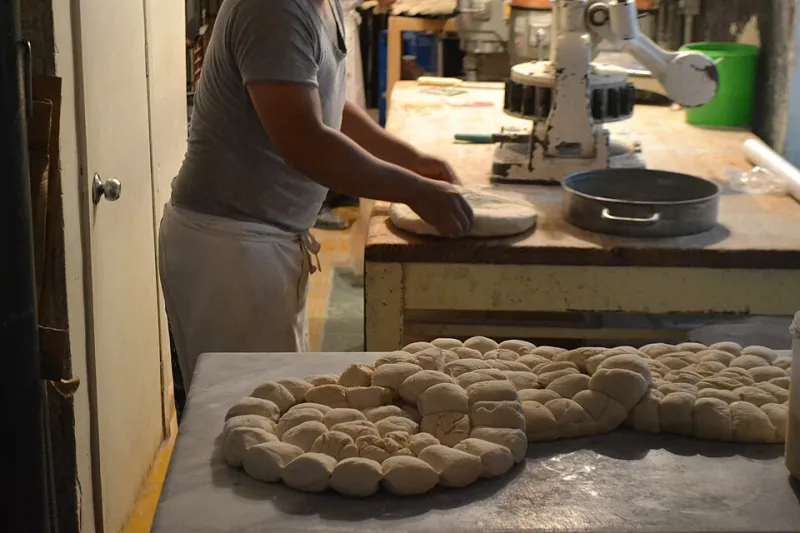
Photo: Katia Flores Torres, CC BY-SA 4.0, via Wikimedia Commons
Scroll through any baking forum or bread-focused Instagram account and you'll notice a pattern. Someone posts a crumb shot, and within seconds the replies flood in asking one question: What was your hydration? It's become the default measure of baking ambition — the higher the number, the more serious the baker. Seventy-five percent? Respectable. Eighty-five? Now we're talking. Ninety-plus? You must really know what you're doing.
Except that's not quite how it works.
Hydration percentage — the ratio of water to flour by weight — is a genuinely useful tool. But somewhere along the way, it became a goal instead of a variable. And that shift in thinking is quietly ruining a lot of loaves.
What Water Actually Does in Dough
At its most basic, water in bread dough does three things: it hydrates the proteins in flour to form gluten, it activates enzymes that begin breaking down starches, and it gives yeast and bacteria the environment they need to ferment. None of those functions require maximum water to work well. They require the right amount of water for the specific flour, method, and timeline you're working with.
Here's the part that often gets skipped in online discussions: flour isn't a fixed variable. A bag of bread flour from one brand absorbs water differently than the same weight from another. Whole wheat flour, with its bran and germ still intact, soaks up significantly more water than white flour. Freshly milled flour behaves differently than flour that's been sitting in your pantry for three months. Even the humidity in your kitchen affects how much water your dough actually needs on any given day.
When you pick a hydration target based on what someone else baked — without accounting for your flour, your environment, or your technique — you're essentially following a map drawn for a different city.
The Open Crumb Myth
The big promise of high-hydration dough is that gorgeous, irregular crumb structure. Those big, uneven holes that scream artisan bakery are genuinely beautiful, and yes, moisture plays a role in achieving them. But hydration is only one piece of a much bigger puzzle.
Open crumb is primarily a product of fermentation, shaping, and scoring — not water percentage alone. A dough at 75% hydration that's properly fermented, shaped with good tension, and scored confidently will almost always outperform a 90% hydration dough that was underproofed, handled too roughly, or baked without steam. The water gives the crumb room to open, but the structure has to be there first.
What very wet dough actually does, if your technique isn't ready for it, is make everything harder. It sticks to surfaces. It's difficult to shape with any real tension. It spreads sideways instead of rising upward. The loaf bakes up flat, dense, and gummy in the center — which is the opposite of what all that water was supposed to deliver.
When Dialing Back Actually Helps
There's a real argument to be made for working at lower hydrations, especially when you're building skills or troubleshooting problems. Dough in the 68–74% range is far more forgiving. You can handle it, stretch it, fold it, and shape it without fighting the bench the whole time. The feedback loop is clearer — you can actually feel what the gluten is doing instead of just hoping the whole wet mass holds together.
Bakers who work with lower-protein all-purpose flour (common in many US supermarket brands) often find that backing off hydration produces noticeably better results. High-protein bread flour can handle more water because it builds stronger gluten networks. All-purpose flour, sitting around 10–11% protein, simply doesn't have the same capacity. Pushing a weaker flour to 80% hydration doesn't make it perform like a strong flour — it just makes it slack and hard to manage.
Similarly, if you're doing a same-day bake without a long cold ferment, high hydration can work against you. Extended cold fermentation (the kind that happens in your fridge overnight) gives the flour time to fully absorb water and for gluten to relax and develop. Without that time, a very wet dough often feels unmanageable and bakes up with less structure than a slightly drier dough that was handled more efficiently.
A Simple Way to Find Your Actual Sweet Spot
Rather than chasing someone else's hydration number, try this: start with a reliable recipe at a moderate hydration — somewhere around 72–75% for a standard white or mostly-white loaf — and bake it twice without changing anything else. Get familiar with how the dough feels at each stage. Then, on a third bake, increase the water by 2–3% and pay attention to what shifts.
Does shaping get harder? Does the loaf spread more? Does the crumb actually open up, or does it stay about the same? You're not looking for a dramatic transformation. You're looking for information. Over time, this kind of incremental testing tells you far more about your specific flour and kitchen than any single viral recipe ever will.
If you find that the extra water creates problems you can't easily solve, that's not a failure — that's data. It means you either need to develop more handling technique before going wetter, or your flour genuinely performs better at a lower hydration. Both of those are completely valid outcomes.
Respecting the Whole System
Bread is a system. Flour, water, salt, time, temperature, and technique all talk to each other constantly. Changing one variable without thinking about the others is how you end up confused about why your loaf didn't turn out like the one in the tutorial, even though you followed the exact same hydration.
The bakers who consistently produce great bread — whether they're working out of a professional bakery in San Francisco or a home kitchen in Ohio — aren't necessarily using the highest hydration they can manage. They're using the hydration that works best for their flour, their process, and the result they're after. Sometimes that's 85%. Sometimes it's 70%. The number itself isn't the point.
At Bill Baker's, we've always believed that understanding why something works is more valuable than copying what someone else did. High hydration is a tool, not a trophy. Use it when it genuinely serves your bake — and don't be afraid to put it down when it doesn't.