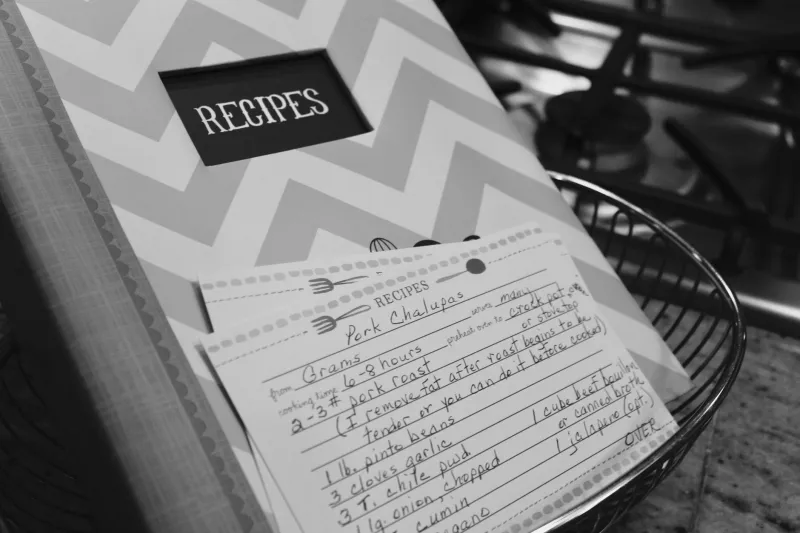
Lost in Translation: Turning Grandma's Fuzzy Instructions Into Recipes That Actually Work
Photo: vintage handwritten recipe card on wooden table with baking ingredients, via i.pinimg.com
Somewhere in America right now, someone is staring at a water-stained index card trying to figure out what "a good handful" of flour actually means. The handwriting is familiar. The memory attached to it is vivid — the smell of that kitchen, the particular shade of brown on those cookies. But the instructions themselves? They might as well be written in code.
This is the baker's inheritance problem. We receive the recipe, but we don't automatically receive the decades of muscle memory, sensory knowledge, and kitchen intuition that made it work in the first place. Transcribing it word for word gets you the artifact. What you actually need is the translation.
Why Old Recipes Are Written the Way They Are
It helps to understand why your grandmother's recipe sounds the way it does. She wasn't being vague on purpose. She was writing shorthand for herself — notes meant to jog a memory, not teach a stranger. Bakers of that era learned by standing next to someone and watching. The recipe was a reminder, not a manual.
Beyond that, measurement tools weren't always standardized the way they are today. "A cup" in 1940s rural Georgia might have referred to an actual teacup sitting on the counter, which holds a different volume than a modern 8-ounce measuring cup. "A pinch" was literal — the amount your particular thumb and forefinger could pinch up. These weren't careless measurements. They were personal ones.
This is why simply copying the recipe into a Google Doc and calling it preserved doesn't actually preserve the recipe. You've kept the words. You haven't kept the knowledge.
Decoding the Language of Sensory Cues
The phrases that stump modern bakers most are the ones that describe outcomes instead of inputs. "Bake until golden." "Mix until it looks right." "Add flour until the dough comes together." These aren't lazy instructions — they're actually more sophisticated than a timer setting, because they're asking you to use your senses instead of a clock.
The problem is that sensory knowledge has to be earned. Here's how to start building the decoder ring:
"Until golden" is a color cue, and color in baking is a real indicator of internal chemistry. A light golden edge on a sugar cookie means the Maillard reaction has started but sugars haven't caramelized deeply yet — the cookie is set but still soft. Deep amber means more caramelization, more flavor, crispier texture. When you're reverse-engineering this phrase, bake a test batch and pull cookies at three different color stages. Taste each one. Write down what you see and what you get.
"A pinch of" for salt or spice is usually somewhere between 1/16 and 1/8 of a teaspoon. Start there and taste. Salt in particular is deeply personal — older recipes often under-salt by modern standards because salt was expensive or rationed at various points in American history.
"Until the dough comes together" is a hydration cue. It means the dough has absorbed enough liquid to hold its shape without crumbling, but isn't sticky. This varies by flour brand, humidity, and even altitude. Document the texture you're after in words that make sense to you: "soft as an earlobe," "tacky but not sticky," "pulls cleanly from the bowl."
Building a Testing Framework
Here's a practical approach that treats recipe translation like the science project it actually is.
Step one: Make it exactly as written, once. Don't adjust anything. Use whatever quantities you can interpret as literally as possible. This gives you a baseline — even if the result is imperfect, you'll learn what direction to move.
Step two: Identify every variable you couldn't pin down. Make a list. "A handful of oats" — how much did you use, and what did the texture tell you? "Bake in a moderate oven" — what temperature did you guess, and was the result over or underdone? These are your translation gaps.
Step three: Standardize one variable at a time. Don't overhaul everything at once. If the texture was off, adjust the flour and hold everything else constant. Run that version. Adjust again if needed. This methodical approach sounds slow, but it gets you to a reliable recipe faster than changing five things at once and having no idea what worked.
Step four: Write the recipe in two voices. Document both the original instruction and your translated version side by side. "Bake until golden (approximately 12–14 minutes at 350°F, edges set, center slightly soft)." This keeps the original language alive while giving future bakers something they can actually replicate.
The Stuff the Recipe Will Never Tell You
Some of what made grandma's version taste the way it did genuinely cannot be recovered. The lard she rendered herself. The well water. The cast iron pan that had been seasoned for thirty years. The fact that she always baked on Tuesday mornings after church and the kitchen was a particular temperature.
Accept this. The goal isn't perfect replication — it's faithful interpretation. You're not a copy machine. You're a translator, and good translation always involves judgment calls.
That said, there are environmental factors you can account for. If you know the recipe originated in a Southern kitchen, it was likely developed in a humid climate, which affects how flour behaves. If it came from a high-elevation household in Colorado, leavening amounts may need adjustment for sea-level bakers (and vice versa). If the original baker used cake flour from a brand that no longer exists, you might need to experiment with protein content to match the crumb.
Honoring the Recipe by Improving It
There's sometimes guilt attached to changing an inherited recipe. It can feel like a betrayal — like you're saying the original wasn't good enough. Reframe it. Every recipe in your grandmother's collection was itself an evolution of something older. She adapted her mother's recipe to the ingredients available to her, the equipment she had, the tastes of her family. You're doing the same thing.
Modernizing a recipe for consistency and scalability isn't disrespectful. It's how food culture actually moves forward. The recipes that survive across generations aren't the ones that stay frozen in time — they're the ones that got carried forward by bakers who loved them enough to keep working on them.
Write down what you changed and why. Keep the original card safe. Bake both versions for your family and let people taste the difference. That conversation — about what changed, what stayed the same, what the original meant — is itself a form of preservation that no index card can hold.
The recipe is the starting point. The translation is the gift you give to whoever comes next.