You're Not Bad at Lamination — You're Just Fighting Physics

Here's a frustrating truth about laminated doughs: you can follow every step of a croissant or Danish recipe to the letter, do everything your favorite YouTube baker demonstrates, and still end up with something that looks more like a sad dinner roll than a flaky, honeycombed pastry. And the maddening part? Your technique probably isn't the problem.
What's actually holding most home bakers back isn't their rolling skills or their fold count. It's a gap in understanding the two physical forces that make lamination work — gluten development and steam pressure — and how those forces interact with each other in ways that are genuinely counterintuitive.
Let's break it down.
What Lamination Actually Is (Beyond the Folding)
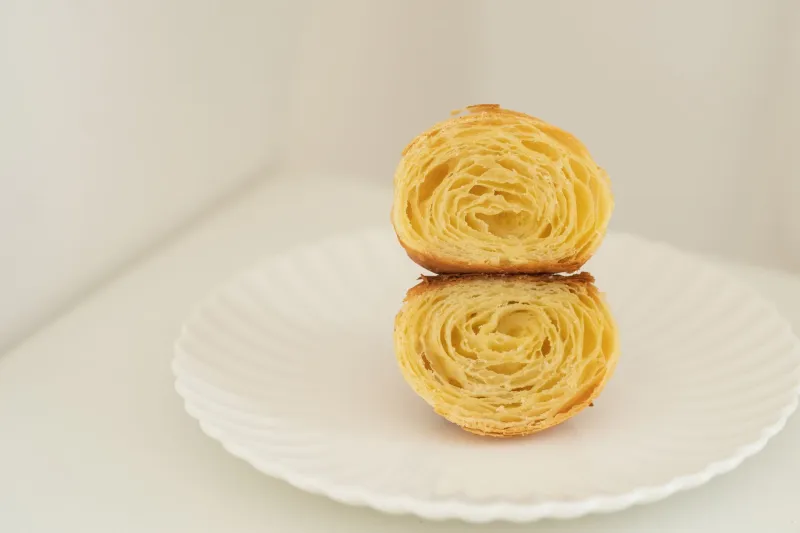
At its core, lamination is the process of trapping fat between thin, alternating layers of dough. When that structure hits oven heat, water in both the dough and the butter converts to steam. That steam, with nowhere to go, pushes the layers apart. The fat melts, the gluten sets, and you get lift.
But here's what the recipe cards don't tell you: this only works if those layers stay physically separate all the way to the oven. The moment your butter smears into the dough rather than staying as a distinct sheet, you've lost the architecture that makes the whole thing function. You're no longer making laminated dough — you're just making enriched dough with extra steps.
So the central question of lamination isn't "how do I fold correctly?" It's "how do I keep my butter and dough from becoming one thing?"
The Gluten Problem Nobody Talks About
Gluten development is usually framed as a goal in bread baking — you want it strong, you want it extensible. In laminated doughs, though, gluten is a double-edged tool, and most home bakers are wielding it wrong.
You need enough gluten structure to hold the layers together and give the steam something to push against. But overworked gluten becomes elastic and tight, which creates two serious problems. First, it fights you during rolling, snapping back every time you try to extend the dough. Second — and this is the part that trips people up — it generates heat through friction.
Every time you wrestle with a resistant dough, you're warming it up. And warm dough is the enemy of lamination. Once your butter softens past a certain point (somewhere around 60–65°F), it stops behaving like a pliable sheet and starts smearing. The layers collapse. The physics fall apart.
This is why more folds do not automatically equal better results. If you're pushing through extra turns on a dough that's already warming up, you're not building more layers — you're actively destroying the ones you had. Counterintuitive, yes. But once you see it this way, you start treating rest time not as a passive waiting period, but as a critical structural intervention.
Cold Is a Tool, Not Just a Precaution
Most recipes tell you to chill your dough between folds. What they often fail to explain is why in terms that actually change your behavior.
When dough rests in the refrigerator, a few things happen simultaneously. The gluten relaxes, making the dough more cooperative during the next roll. The butter firms back up, restoring its ability to act as a separate layer rather than a smear. And the whole system equilibrates — dough and butter reach a similar temperature and consistency, which is crucial because mismatched textures are one of the most common causes of lamination failure.
If your butter is significantly colder than your dough, it shatters when you roll it. If it's warmer, it bleeds into the dough. The goal is a butter block that bends without cracking and a dough that's cold enough to stay firm but not so cold it tears. Getting that balance right in an American kitchen, where ambient temperatures vary wildly from a January morning in Minnesota to a July afternoon in Georgia, requires you to be adaptive rather than just obedient to a timer.
A useful rule of thumb: if your dough feels like cold Play-Doh, you're in the right zone. If it feels like refrigerated clay that resists every push, give it five minutes on the counter. If it starts feeling soft and slightly tacky, get it back in the fridge immediately. Your kitchen temperature is a variable the recipe can't account for — you have to.
The Steam Equation
Once your laminated dough goes into the oven, the fat layers you've carefully maintained do something remarkable: they turn into steam chambers. Each thin layer of butter vaporizes, and that burst of steam is what creates the dramatic lift you see in a well-made croissant.
But steam management doesn't start in the oven — it starts in how you handle moisture throughout the process. Over-flouring your work surface dries out the dough surface, which can affect how the layers seal. Proofing in a dry environment can create a skin on the exterior that resists the steam trying to push through from inside. Even egg wash application matters: too thick a coating can seal the layers at the surface and prevent proper bloom.
One thing worth understanding is that the steam needs a structured path. If your layers have merged or your folds are uneven, the steam disperses unevenly, which is why you sometimes get pastries that are beautifully puffed on one end and dense on the other. The physics don't lie — the structure you built (or failed to build) during lamination is just revealing itself under heat.
Breaking Through the Plateau
If you've been making laminated doughs for a while and feel like you're not improving, the fix probably isn't watching more technique videos. It's shifting your attention from what you're doing to what the dough is telling you.
Start paying attention to resistance. If the dough is fighting your rolling pin, stop and rest it. Start paying attention to temperature — actually use a thermometer on your butter block before you start. Start thinking about your kitchen environment as an active variable, not a fixed backdrop.
And let go of the idea that more folds equal more layers equal better pastry. The number of layers matters far less than the integrity of each one. Six perfect turns beats eight sloppy ones every single time.
Lamination isn't a skill you master through repetition alone. It's a skill you master by understanding what you're actually trying to accomplish physically — and then making every decision in service of that goal. Once the physics make sense, the technique follows naturally. And that's when the plateau breaks.