Why Your Doubled Recipe Is Falling Apart — And How to Scale Batches the Right Way
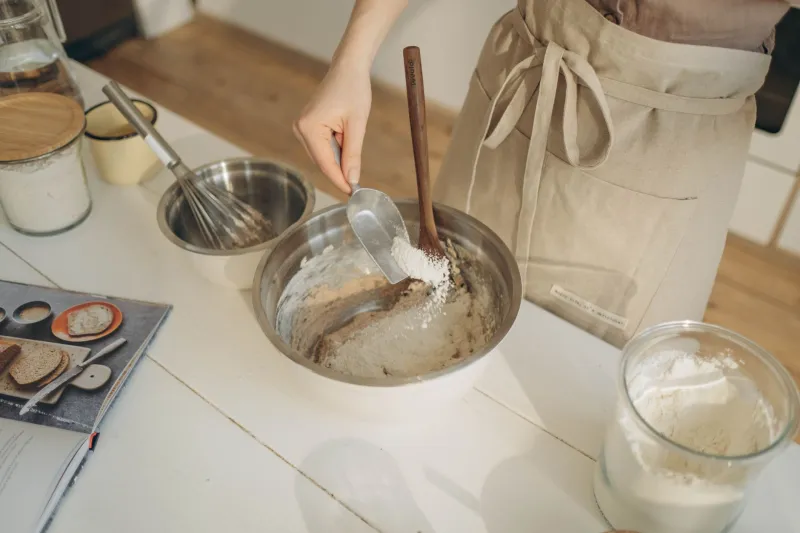
You've made that banana bread a dozen times. It's perfect — golden crust, moist crumb, just the right amount of sweetness. Then a family reunion comes up and you think, easy, I'll just double it. You follow the math, mix everything together, pull it out of the oven, and end up with something dense in the center, weirdly gummy, or just... off. What happened?
Here's the uncomfortable truth: baking isn't cooking. In cooking, doubling a soup recipe is mostly a volume problem. In baking, doubling a recipe is a chemistry problem, a physics problem, and sometimes a timing problem all at once. Understanding why things go sideways when you scale — and what you can actually do about it — will save you a lot of wasted ingredients and a lot of frustration.
The Math-Only Mindset Is the First Mistake
Most home bakers approach scaling with a calculator and confidence. Double the flour, double the eggs, double the baking powder, done. But that logic breaks down fast once you understand that many ingredients in a recipe don't scale linearly.
Leavening agents are the most notorious offenders. Baking powder and baking soda don't need to be doubled just because your batter volume doubled. These ingredients work by generating gas bubbles, and too much of them in a larger batch can actually cause your bake to rise too fast, collapse, or develop a metallic, soapy taste. A good rule of thumb: when scaling up by 2x, use about 1.75x the leavening rather than the full 2x. When scaling to 3x or more, you may need to dial it back even further — closer to 1.5x — and test from there.
Salt is another one. It's tempting to just multiply it out, but salt affects gluten development and fermentation in ways that compound at scale. A slightly conservative approach — scaling salt to about 90% of the multiplied amount — gives you a safer starting point, especially with yeasted doughs.
What Happens to Hydration When You Scale
Here's something most recipe doubling guides skip over entirely: your flour's ability to absorb liquid isn't a fixed value. It depends on the flour's protein content, the humidity in your kitchen, and the temperature of your ingredients. When you double a recipe, you're not just doubling the water — you're also doubling the margin for error.
In a small batch, a tablespoon of extra liquid is manageable. In a doubled or tripled batch, that same proportional error becomes a quarter cup of too-wet dough, and suddenly your cookies spread into puddles or your bread loaf refuses to hold its shape.
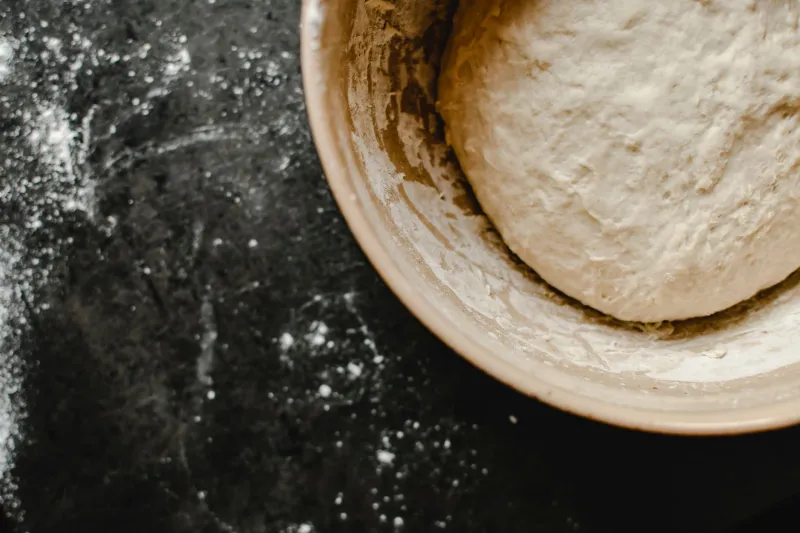
The fix here is to hold back about 10% of your liquid when scaling up, then add it gradually as you mix. Assess the dough's consistency against what you know the original should feel like. This is especially important with bread doughs, where hydration directly controls crumb structure and crust development.
Fermentation Doesn't Double With the Dough
If you bake yeasted breads or anything with a long cold ferment, scaling creates a problem that has nothing to do with measurements: thermal mass. A larger mass of dough holds heat differently than a small one. It takes longer to cool in the refrigerator and longer to warm back up before baking. That means your fermentation schedule — the timing you've dialed in over dozens of bakes — is no longer reliable.
A doubled batch of pizza dough that normally cold-ferments for 24 hours might need an extra 4 to 6 hours to fully develop the same flavor complexity, simply because the center of the dough mass stayed warmer longer before cooling down. Conversely, when you pull it out to proof, that larger mass warms more slowly, so your pre-bake rest might need to extend by 20 to 30 minutes.
The practical advice: don't scale yeasted recipes by just multiplying and hoping. Instead, consider making the same batch twice and managing two separate dough balls through the process. You get the same total yield with far more predictable results.
The Oven Is Not on Your Side
Your oven has a fixed interior volume and a heating element that was designed to maintain temperature under a certain baking load. When you fill it with twice as many pans, or switch from an 8-inch round pan to a 9x13 sheet, you've changed the thermal dynamics of the whole system.
More mass in the oven means the temperature drops more sharply when you open the door and place your bakes inside. It also means the air circulation — which is what creates that even browning you love — gets disrupted. A doubled batch baked in two loaf pans side by side will bake differently than two separate single batches baked one at a time.
If you're scaling up and baking multiple pans at once, rotate them halfway through. Budget an extra 5 to 10 minutes of bake time and start checking for doneness earlier than you think you need to. An instant-read thermometer is your best friend here — internal temperature doesn't lie the way visual cues sometimes do.
Pan Size Changes Everything Too
Scaling isn't only about batch quantity. Sometimes you want to bake the same recipe in a different pan — say, moving from two 8-inch rounds to one 9x13 for a sheet cake. The batter volume might be similar, but the depth of the batter changes dramatically, and depth controls how heat travels through the bake.
A shallow 9x13 pan will bake faster and set more quickly than a deeper 8-inch round. The edges will be done while the center is still catching up. For cakes, this usually means dropping your oven temperature by 25°F and adding 10 to 15 minutes to the bake time. For brownies or bars, it can mean the difference between fudgy and dry.
Always recalculate your expected bake time when you switch pan sizes, even if the total batter volume is identical.
The Ingredients That Actually Scale Cleanly
Not everything is this complicated. Some ingredients are genuinely forgiving at scale:
- Flour scales predictably as long as you measure by weight, not volume.
- Sugar scales well, though you may want to reduce slightly in very large batches to avoid over-browning.
- Fats (butter, oil) scale reliably in most cases.
- Extracts and spices are tricky — they tend to intensify at scale, so hold back slightly and adjust to taste.
- Eggs are the wild card. You can't split an egg easily, so sometimes a scaled recipe lands on 2.5 eggs. Round down for denser bakes, round up for lighter ones.
A Smarter Approach to Scaling
The most reliable method for scaling a beloved recipe isn't to do it all at once. Scale in increments — 1.5x before you try 2x, 2x before you try 3x. Document what you changed, what the dough felt like, how long it actually took in the oven, and how the finished product compared. Over two or three test batches, you'll build a scaled version of the recipe that you trust as much as the original.
Baking is always a relationship between ingredients, environment, and technique. Scaling just adds a few more variables to manage. Once you understand where the friction points are — leavening, hydration, fermentation, and heat — you're not guessing anymore. You're baking with intention. And that's when the results start to match what you had in mind.